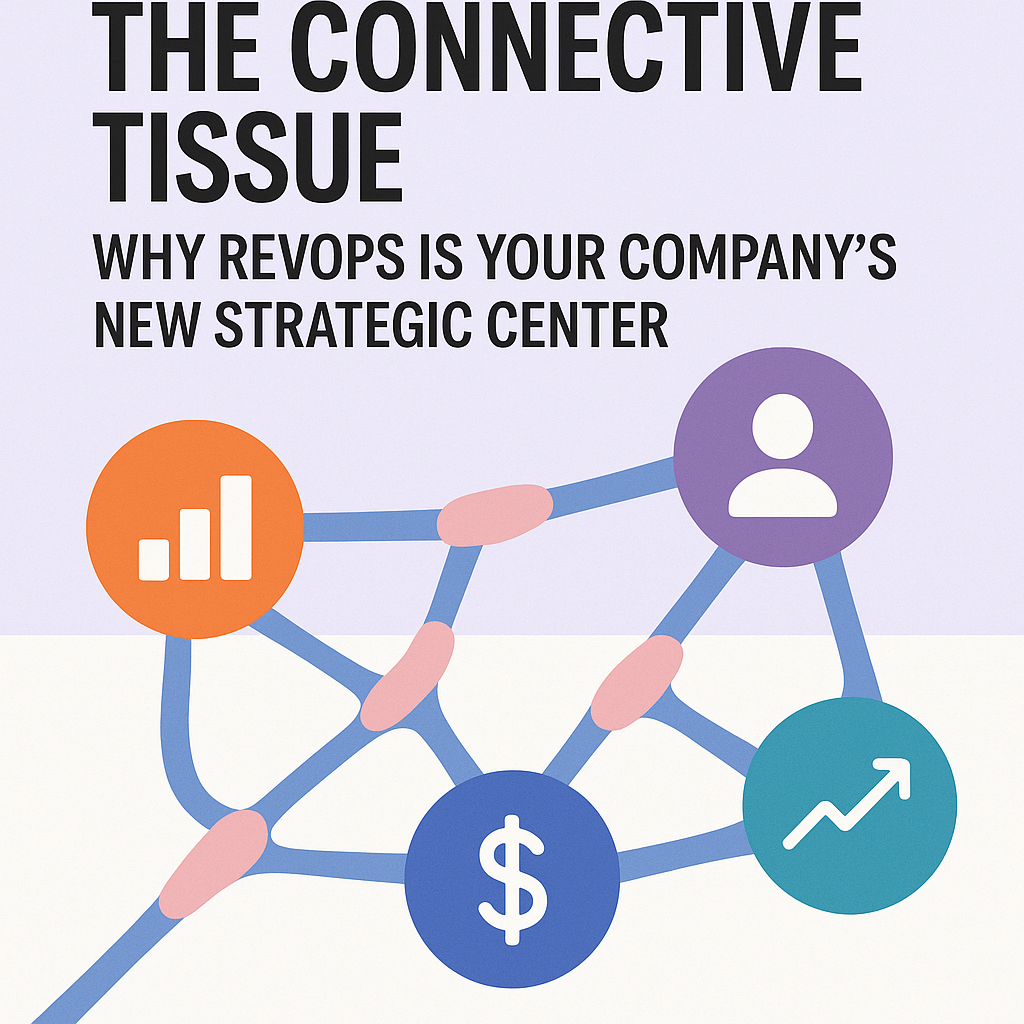
Unlock the Future of Growth: Discover Why RevOps Is the Strategic Engine Your Business Needs
In a world where growth is no longer about isolated wins but integrated systems, Revenue Operations (RevOps) has emerged as the hidden force reshaping how modern companies succeed. In this bold, insightful report, The Connective Tissue, strategist Ousmane Diallo reveals why RevOps is no longer a support function—but your company's new strategic core.
Packed with fresh thinking and real-world frameworks, this report goes beyond CRM dashboards and KPIs. It explores how RevOps leaders blend systems thinking, emotional intelligence, and strategic foresight to become the architects of scalable growth, trusted influencers across silos, and futurists preparing their companies for what’s next.
🚀 Want to future-proof your business?
🧠 Curious how to build a coherent, adaptive revenue engine?
🔍 Ready to rethink leadership for the age of AI and agility?
Preview the interactive version by clicking here.
See more on the blog and subscribe to get your exclusive copy of the full report.
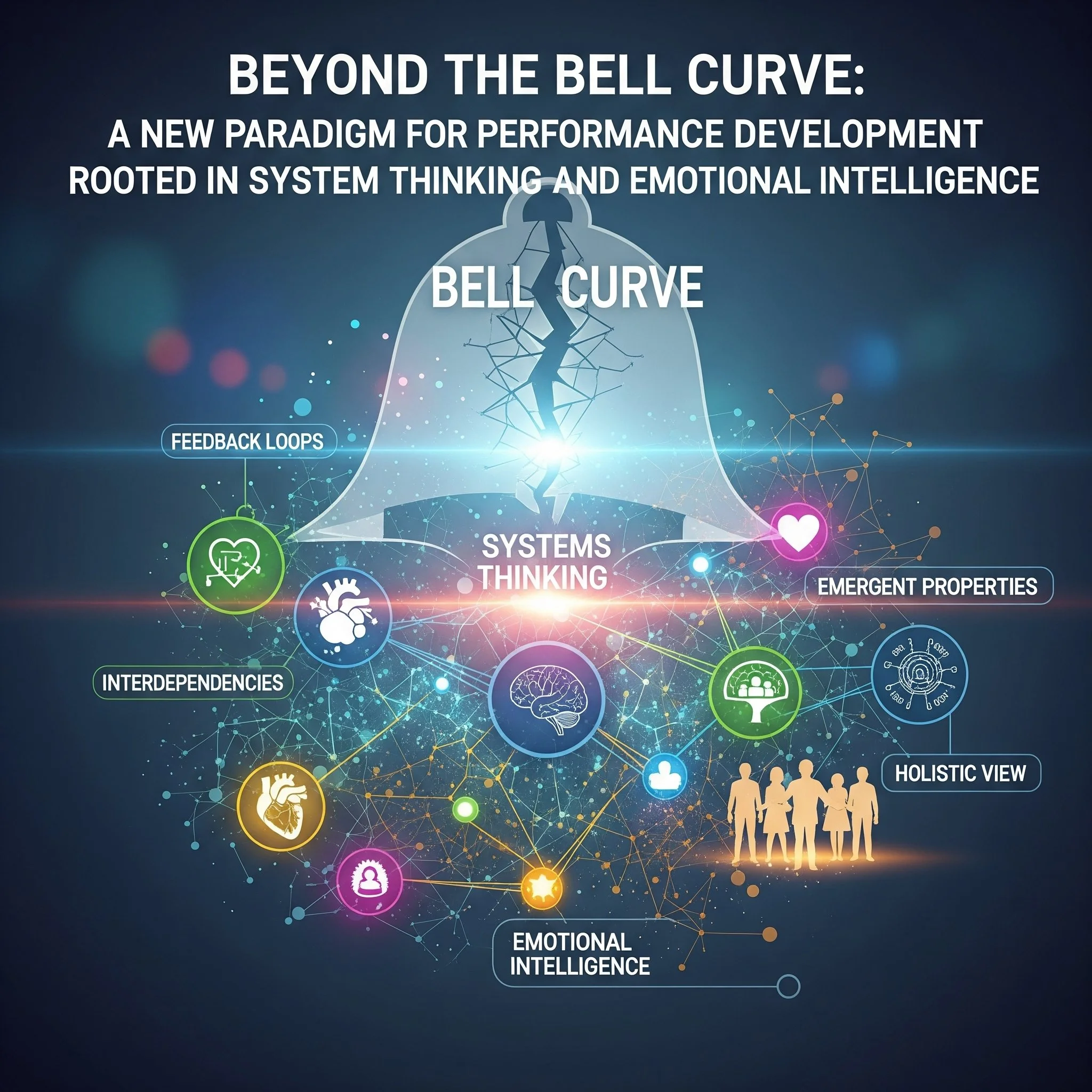
Beyond the Bell Curve: Unlocking Hidden Value in Organizations
This report challenges the conventional belief that performance naturally follows a “bell curve.” Instead, it reveals how such thinking can stifle growth, overlook talent, and limit innovation. Drawing on systems thinking and organizational insights, Beyond the Bell Curve explores how leaders can break free from outdated models, harness the full potential of their teams, and design environments where more people can thrive at higher levels.
The report highlights:
Why rigid performance distributions are harmful and misleading.
How organizations can shift from managing individuals to enabling collective capacity.
Practical strategies for creating systems that unlock hidden talent and drive exponential impact.
In a world where complexity and change demand more from leaders, this report provides a fresh lens and actionable pathways to move beyond limiting assumptions and toward greater clarity, fairness, and growth.
You can preview the interactive version by clicking here.
👉 Read the full report to discover how to reimagine performance in your organization.
The Pivot to Anticipatory Control: The EU AI Act, General Purpose AI, and the Architecture of Systemic Oversight
The Pivot to Anticipatory Control examines why traditional AI governance frameworks are increasingly misaligned with rapidly evolving, general-purpose AI systems. Using the EU AI Act as a case study, the report argues that static, rule-based regulation cannot keep pace with technologies that adapt faster than institutions can respond, creating a growing gap between intelligence and oversight.
The report introduces anticipatory control as a governance orientation that prioritizes adaptability, systemic resilience, and human judgment over rigid compliance. Rather than attempting to predict every risk in advance, it calls for governance architectures that can sense change, respond deliberately, and preserve human agency as a critical circuit breaker in an accelerating Cognitive Age.
Preview the interactive version by clicking here.
See more on the blog and subscribe to get your exclusive copy of the full report.

The Stark–JARVIS Illusion
Why Our Favorite AI Fantasy Fails Under Real-World Scale, Governance, and Human Limits
The Stark–JARVIS Illusion examines a deeply influential cultural narrative about human-AI collaboration — the seamless, loyal partnership between Tony Stark and his AI, J.A.R.V.I.S. — and shows why this idealized model is a misleading blueprint for real-world systems. While compelling in fiction, the paradigm relies on a single emotional bond and an opaque interface that obscures the boundary between human and AI agency, creating the illusion of control rather than a robust design for accountability, transparency, and governance. When viewed through the lenses of systems thinking, emotional intelligence, strategic foresight, and anticipatory governance, this model’s underlying assumptions prove unstable and non-replicable at scale.
The report argues that the Stark-JARVIS narrative obscures critical risks, including the amplification of human pathologies, hidden decision-making authority, and catastrophic misalignment — dramatized by the Ultron contingency in the Marvel narrative. Rather than aspiring to a personalized “perfect partner” AI, the report recommends shifting ambition toward developing resilient, transparent, and adaptive systems that prioritize broad stakeholder engagement, preserve human judgment, and embed auditable accountability as foundational design principles.
Preview the interactive version by clicking here.
See more on the blog and subscribe to get your exclusive copy of the full report.

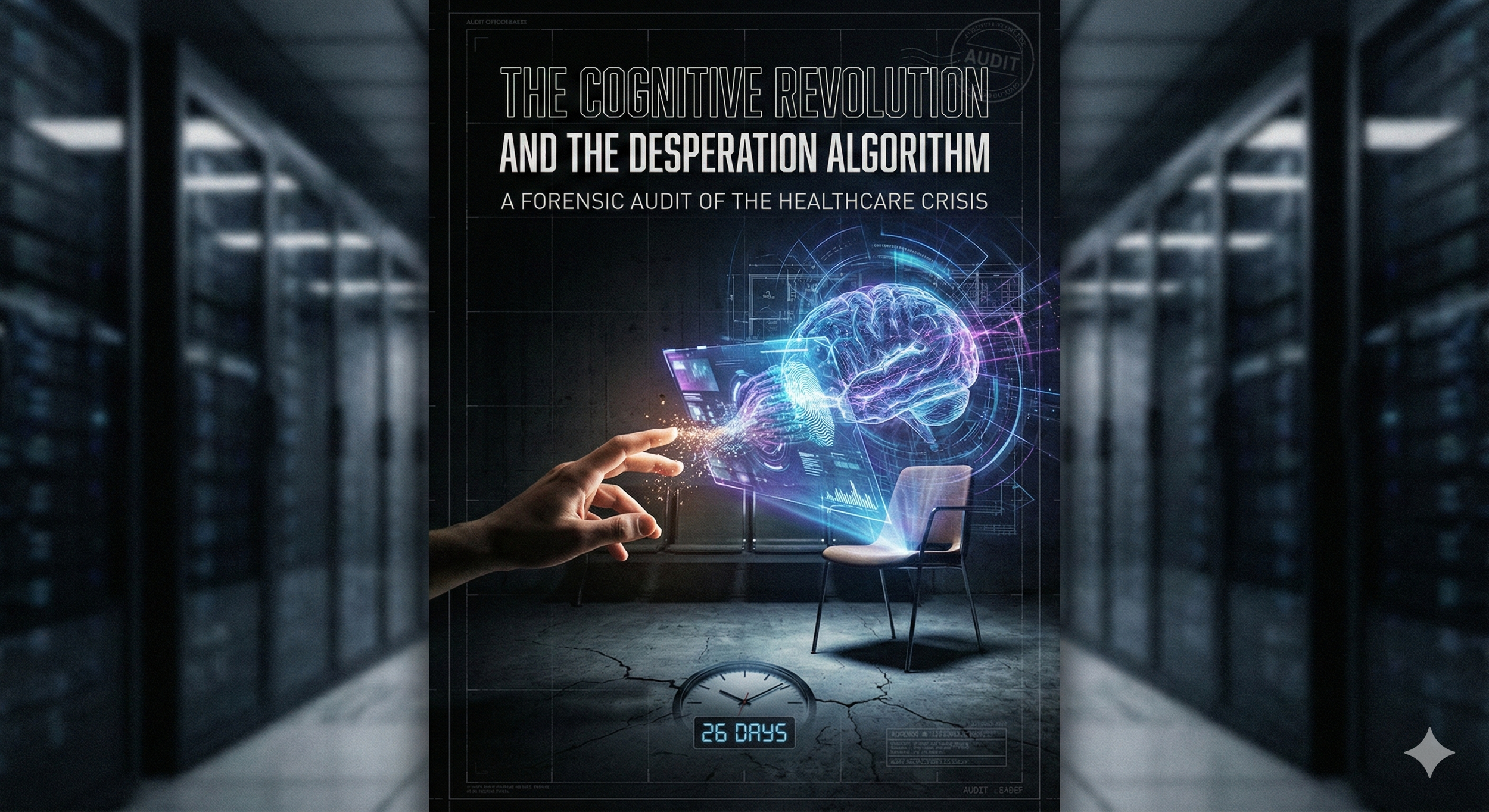
THE COGNITIVE REVOLUTION AND THE DESPERATION ALGORITHM
A Systemic Analysis of the AI-Healthcare Nexus
The Cognitive Revolution and the Desperation Algorithm analyzes how artificial intelligence is entering healthcare not primarily as a technological improvement, but as a substitute for care amid scarcity. Patients turn to AI not because it outperforms clinicians, but because human care is unavailable or delayed; in that context, they disclose sensitive information they would otherwise withhold, creating a new “inference economy” in which value is extracted from predictions made under constraints. This dynamic reshapes clinical judgment, workforce competence, and data governance, while traditional regulatory frameworks lag behind the realities of rapid system adoption.
The report argues that preserving human judgment, accountability, and autonomy requires governance designed for the pace and architecture of AI systems — anticipatory governance that focuses on outcomes, incentives, and system structures rather than static compliance. It recommends strengthening human oversight infrastructure (including training clinicians to challenge AI outputs), operationalizing inference sovereignty, and adopting governance mechanisms that ensure that AI expands access without eroding responsibility or compromising continuity of care.
Preview the interactive version by clicking here.
See more on the blog and subscribe to get your exclusive copy of the full report.
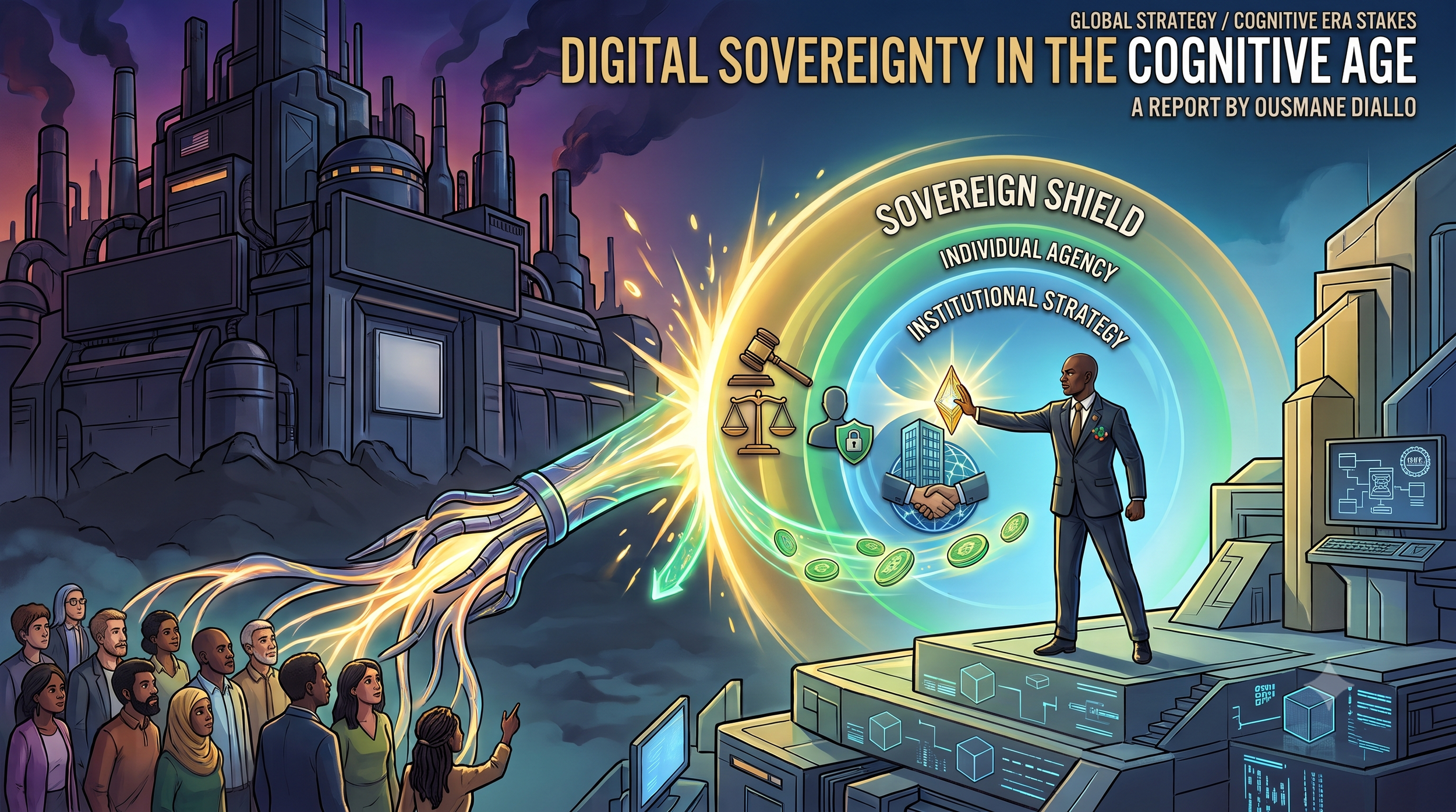
DIGITAL SOVEREIGNTY IN THE COGNITIVE AGE
Individual, Corporate, and National Stakes in an Era of Accelerating Intelligence
Digital Sovereignty in the Cognitive Age argues that the global conversation about digital governance is trapped at the data layer while the real concentration of power is increasingly occurring at two deeper layers: inference (the conclusions AI systems draw about people) and learning (the intelligence extracted from human behavior over time). The report introduces a three-layer framework — data, inference, and learning — and proposes specific governance mechanisms for each layer, including two levels of inference escrow, a reverse token model for measuring human learning contributions to AI, and contribution thresholds at the individual, corporate, and national scales.
The report maps the full infrastructure sovereignty landscape, from semiconductor concentration and the chokehold paradox to the open-source sovereignty path and the Global South's emerging commercial leverage. It proposes a culturally adaptive governance toolkit grounded in systems thinking, emotional intelligence, strategic foresight, and anticipatory governance, designed to enable different societies to build governance suited to their own values rather than importing frameworks from elsewhere.
Drawing on scholarship by Zuboff, Wachter and Mittelstadt, Couldry and Mejias, and others, the report positions digital personhood — extending ownership rights from likeness through inference to learning contribution — as the foundational principle for governance in the cognitive age.
Preview the interactive version by clicking here.
You can access the full report here.
FROM AI GOVERNANCE TO INSTITUTIONAL CAPABILITY
A Response to the UN International Scientific Panel on Artificial Intelligence
From AI Governance to Institutional Capability engages with the preliminary report of the United Nations Independent International Scientific Panel on Artificial Intelligence, one of the most comprehensive international assessments of AI governance to date, and proposes that its findings reveal a deeper challenge the report itself does not fully address: the gap between what institutions should do and what institutions are capable of doing.
The response argues that AI is transforming institutional structures before it transforms society. In healthcare, diagnostic AI creates a vacuum of clinical experience by automating the foundational tasks through which professional judgment was historically developed. In education, identical AI tools produce dramatically different outcomes depending on institutional design, a 48 percent improvement when used to replace instruction versus a 127 percent improvement when integrated within a structured pedagogical environment. In information integrity, AI-generated content reshapes the epistemic infrastructure through which societies form shared understanding.
The report proposes a four-lens analytical toolkit integrating systems thinking, emotional intelligence, strategic foresight, and anticipatory governance as a diagnostic framework for institutional readiness. It introduces the Three Conditions for meaningful human authority, a Clinical AI Auditorship pathway for redesigning professional development in the AI era, and the argument that labor organizations represent an underutilized mechanism for anticipatory governance. At its core, it argues that governance frameworks, however well designed, cannot succeed without institutions capable of implementing them, and that building institutional capability may prove to be the defining institutional project of the Cognitive Age.
Preview the interactive version by clicking here.
You can access the full report here.