
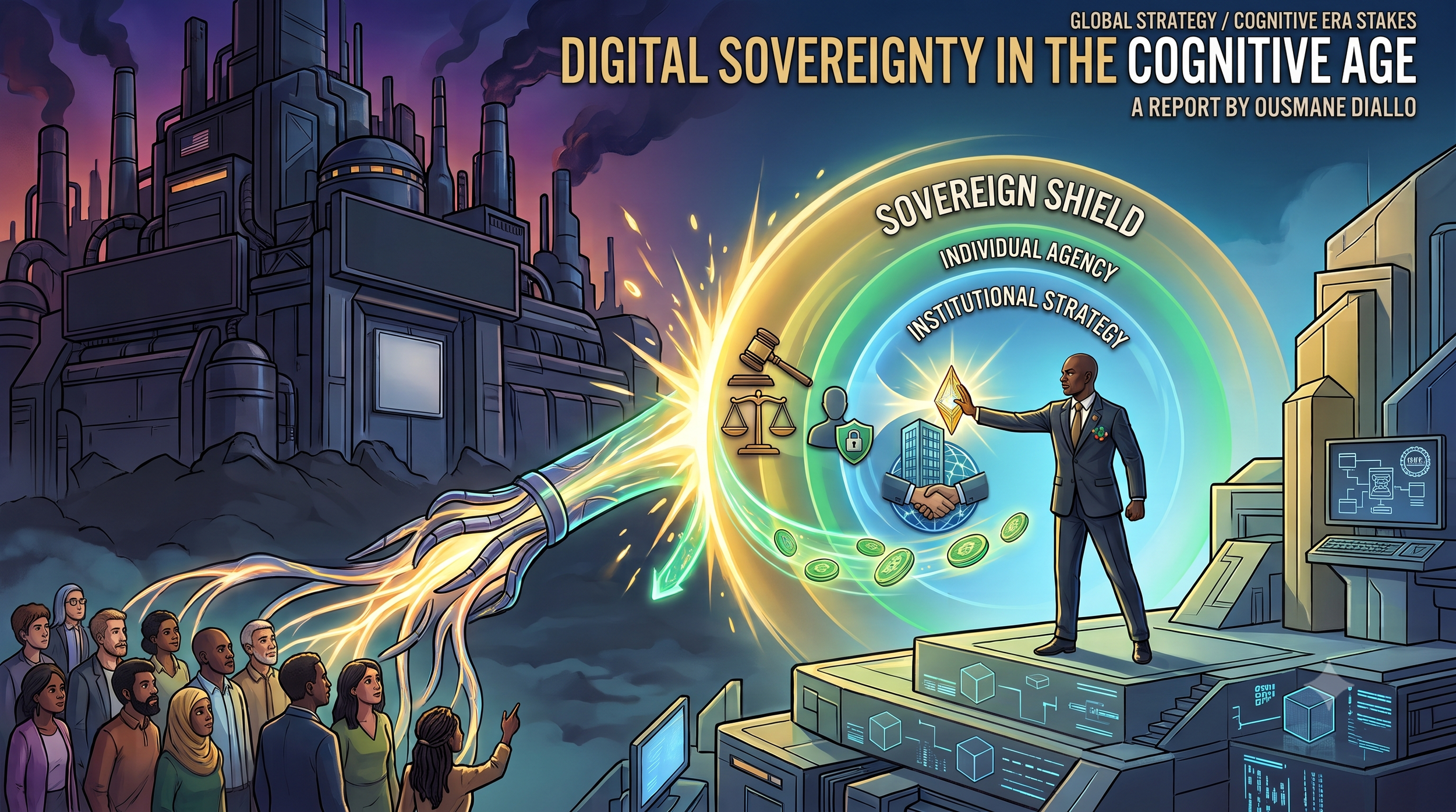
Every Interaction Generates Three Layers of Value.
Our current laws only govern the Input (Data). They ignore the computed Output (Inference), and completely fail to measure the compound Asset (Learning) generated by human behavior.
The Facts You Declare
Explicitly stated metrics, histories, inputs. Governed heavily by GDPR, HIPAA, or PIPL.
The Silent Predictions
Conclusions drawn from behavior that you never stated and may never see. Governed by no framework.
The Cumulative Capability
How your corrections and actions permanently upgrade the AI factory itself. Completely captured by foreign SaaS providers.
The Sovereignty-Convenience Spectrum
Every step toward convenient computing is a silent structural trade-off. Use the interactive slider below to trace how service choices impact sovereign control over derived intelligence.
Bare Metal Cloud
Dedicated physical hardware rented on demand. Removes virtualization vulnerabilities, but you still rely on third-party center operations.
Sovereignty Assessment
Implications & Risks
- ▸ Rented chips can be geo-fenced or access revoked.
- ▸ Derived learning is easily harvested by network switches.
Three Legal Traditions, One Common Failure.
Data protection has advanced along three primary axes. Yet, all three suffer from a terminal bottleneck: they govern the input (raw facts) while leaving the derived output completely unregulated.
Western Rights
GDPR Model
The person is the primary legal unit. Individual dignity and explicit consent act as a buffer, yet the model fails to prevent remote corporate harvesting of inferred intelligence.
Sovereignty-First
PIPL / "3+1" System
Individual privacy is subordinate to state security. High capacity for immediate state enforcement and localized learning storage, but lacks individual protections when priorities clash.
Development-First
Global South Frameworks
AU Continental AI Strategy & Brazil's PBIA. Built around development realities (health, ag, scarcity). Focuses on building local compute stacks rather than copying Western rules.
The Digital Personhood Pathway
Rights must expand as intelligence accelerates. Trace the legal expansion from protecting the physical self to claiming the derived cognitive output.
01. Likeness Sovereignty
Ownership over physical self. Pioneer example: Denmark’s 2025 proposal granting individuals legal rights over body scans, facial features, and voice prints.
02. Inference Escrow
Protection of predicted state. Inferences treated as time-bound, purpose-limited artifacts locked inside a localized, secure safe deposit box.
03. Learning Contribution
The final frontier. Measuring and crediting human judgment that updates AI model parameters. Governed through Reverse Tokens.
Centralized Harvesting vs. Federated Escrow
To operationalize sovereignty, we must separate Data, Learning, and Inference. Use the toggle below to watch how learning streams bypass centralization under a federated architecture.
The Reverse Token Model
Existing systems meter exactly what they deliver to you. Our model measures the inverse flow: the value of the clinical corrections, educational pattern adaptations, and judgment validations you provide.
Input Parameters
SaaS vs. Reverse Flow Valuation
Net Result: Deficit of Accountability
Your clinical corrections permanent update the general model. Standard accounting charges you $4.50, completely obfuscating the $22.50 contribution value extracted by the developer.
The Multi-Tiered Governance Framework
A system-level response mapped across all structural players inside the Al-Healthcare and Cognitive Ecosystem.
Two-Level Inference Escrow
Systemic escrow for contexts of vulnerability (federated parameter storage) and personal safe deposit box mechanisms for contexts of active human agency.
Three Conditions of Human Authority
Human review must ensure reviewer proximity to contextual data, explicit authority to override AI, and sufficient time to reflect rather than rushing.
Individual Empowerment
Reversing the asymmetry by assigning explicit digital personhood rights. A person holds the direct encryption keys to predictions made about their body and behavior.
A Culturally Adaptive Toolkit
Sovereignty architectures differ globally, but all successful governance models rely on the same four critical lenses.
Systems Thinking
Understanding the compound loop where raw inputs, inferences, and learning feed into physical chip layers and geopolitical supply blocks.
Emotional Intelligence
Keeping human vulnerability visible. Refusing to let the clinical needs of patients disappear behind administrative scaling abstractions.
Strategic Foresight
Mapping locking infrastructure. Intervening before network effects cement permanent monopolies that cannot be unwound.
Anticipatory Governance
Moving regulatory control upstream. Designing structures that validate parameter adaptation rather than issuing static certificates.