
Anticipatory Control
The Governance Gap
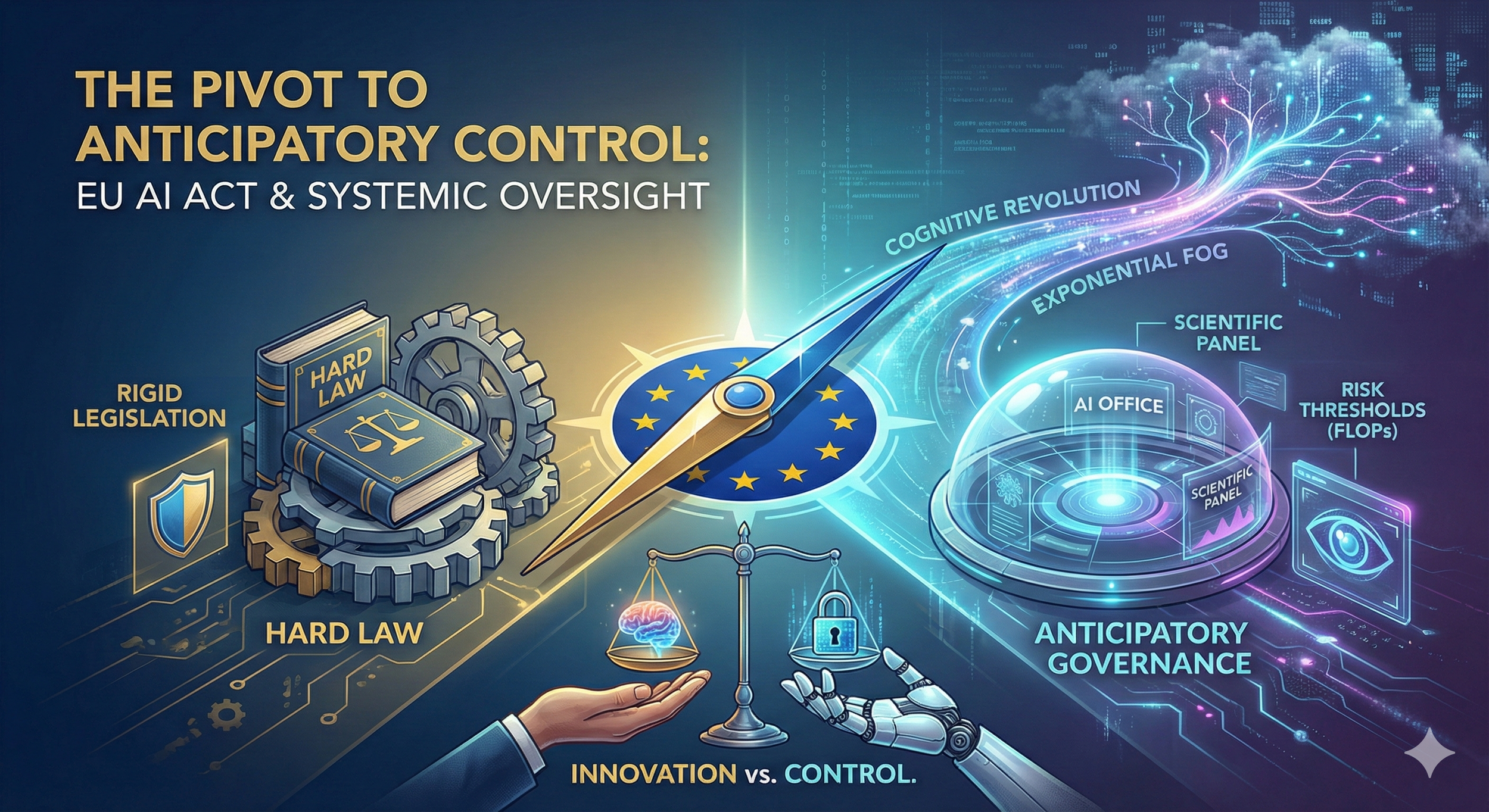
The "Cognitive Revolution" has created a pacing problem: AI evolves exponentially, but regulation evolves linearly. The EU is solving this via Anticipatory Governance—steering technology before risks become entrenched.
Systems Thinking
Governance now views AI as a complex ecosystem, monitoring the "Inference Economy" rather than just isolated code.
Strategic Foresight
Using the Scientific Panel to stress-test policies against future capabilities (e.g., AGI).
Agile Oversight
Moving from rigid "hard law" to flexible "soft law" (Codes of Practice) to adapt to new threats.
GPAI Risk Classifier
Determine obligations based on the 4 Systemic Risk Levers.
The Architecture of Control
Oversight has been centralized to handle the "Brussels Effect" and ensure cross-border consistency.
🇪🇺 AI Office
Centralized enforcer for GPAI models and vertically integrated systems like ChatGPT.
🔬 Scientific Panel
Can issue "Qualified Alerts" to investigate risks even if compute thresholds aren't met.
📜 Code of Practice
Provides a "presumption of conformity." Includes the Safety and Security Framework (SSF).
The "Digital Simplification" Pivot
Driven by the Draghi Report, the EU proposed significant changes to boost competitiveness.
| Change | Impact |
|---|---|
| Delay High-Risk Rules | Delayed 16-18 months to await standards. |
| GDPR Reform | Allows "Legitimate Interest" for training without consent. |
| SME Rules | Extended to "Small Mid-Caps". |
Critique: "Rollback"
Civil society argues delaying rules and loosening GDPR prioritizes profit over rights.
Defense: "Agility"
Proponents argue this prevents legal uncertainty and closes the innovation gap.