
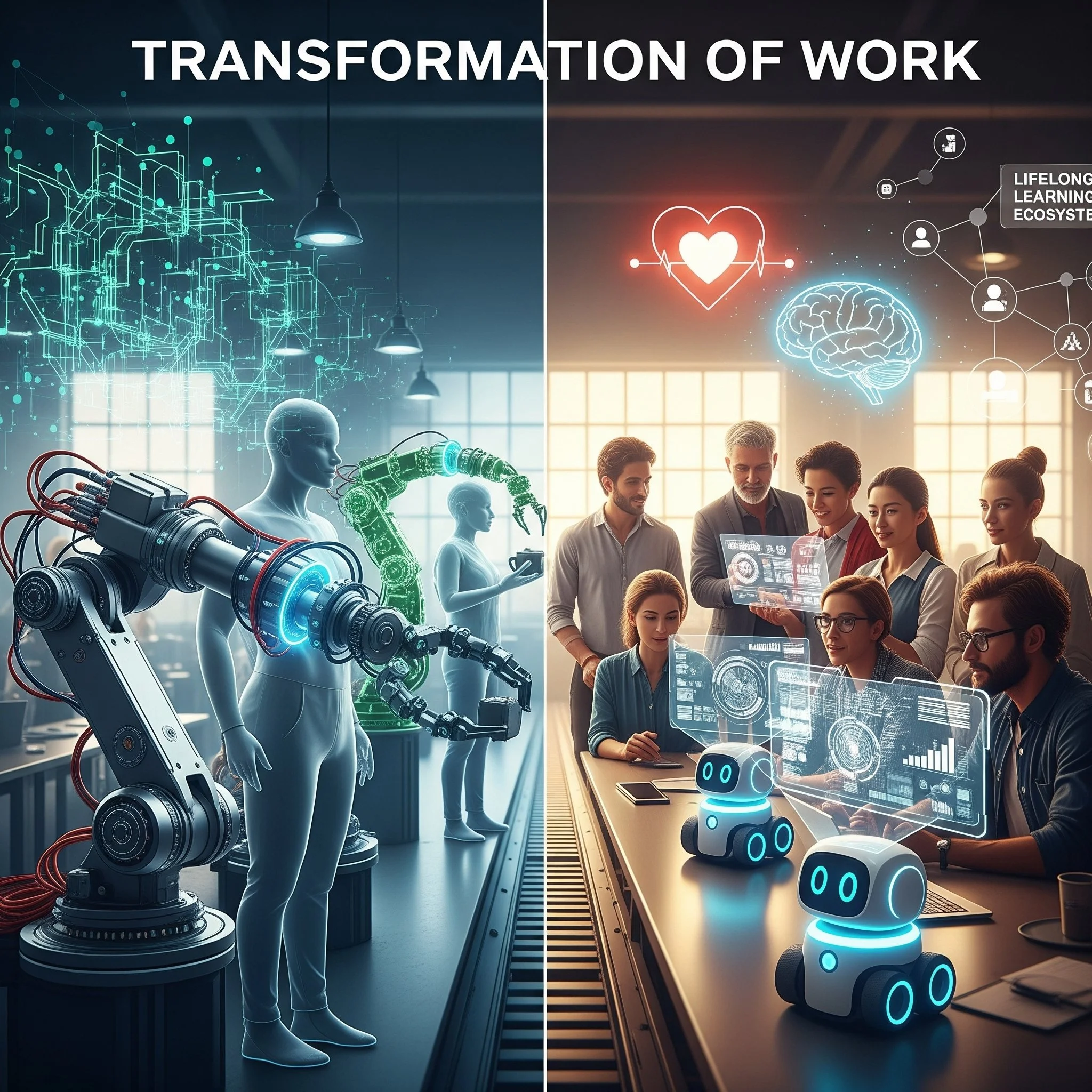
The Transformation of
Work, Worth, and Workforce
The AI revolution shockwaves are felt most acutely in human labor. The challenge is not mass unemployment, but mass adaptation—a rebalancing of tasks and uniquely human skills.
The Rise of the Robotic Workforce
Global Robot Density
Industrial robots per 10,000 employees has more than doubled since 2016.
Top 5 Robot Markets
Asia is the dominant market, with China accounting for 51% of global installations in 2023.
The Rise of Cobots
The most significant shift is from replacement to collaboration. Collaborative robots, or "cobots," are designed to work alongside humans, combining robotic strength and precision with human creativity and problem-solving. This enhances productivity and makes automation accessible to smaller businesses.
The Rebalancing of Labor
AI is not a singular force that destroys jobs; it is a catalyst for a complex rebalancing of tasks. The impact is a spectrum of displacement, augmentation, and creation.
The Automation of Routine Tasks
AI is most effective at automating rules-based, repetitive tasks, impacting roles like data entry, junior paralegal research, and basic coding. This is creating a "mobility crisis" by eroding entry-level jobs that have traditionally been the first rung on the career ladder.
The Human-in-the-Loop "Copilot"
More common than replacement is augmentation, where AI handles routine work, freeing humans for higher-value tasks. A study found AI assistants boosted productivity by up to 34% for less experienced workers, acting as a powerful on-the-job training tool.
The Emergence of New Roles
Just as past revolutions created new industries, AI is creating entirely new job categories. These include technical roles like AI/ML Engineers, interface roles like Prompt Engineers, and governance roles like AI Ethics Auditors.
The Human Advantage: EQ
What AI Excels At
Pattern Recognition, Data Analysis, Calculation, Simulation
The Human Advantage
Genuine Empathy, Original Creativity, Value-Aligned Moral Judgment
Workforce Adaptation Strategies
Corporate Strategy
Strategic Workforce Planning
Modernizing Apprenticeships
Role of Labor
Proactive Bargaining
Partnership Models
The Lifelong Learning Ecosystem
Shared Responsibility
Are You Future-Ready?
How often do you proactively learn new skills for your career?